
Resilience
Supply Chain Resilience: Third-Party Protection
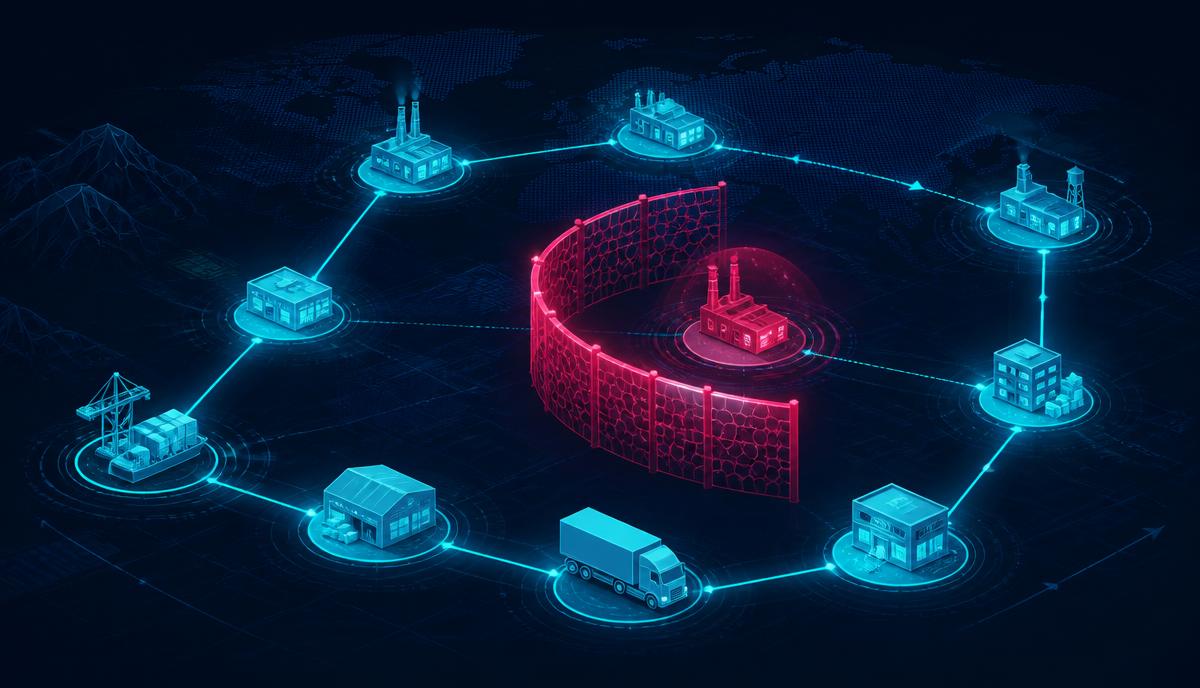
Your recovery capability depends on a chain of third-party services: cloud providers, backup vendors, identity platforms. When any link in that chain is compromised, your recovery depends on assets you control physically.

Mark FermorCTO, CMO & Founder, Firevault
Published 19 February 2026 · 4 min read
The Chain You Cannot See
Modern organisations depend on complex supply chains of technology services. Your production data runs on a cloud platform. Your backups are managed by a backup vendor. Your identity system is provided by a third party. Your DNS is managed by another. Your certificates are issued by yet another.
Each of these services represents a dependency in your recovery chain. And each is operated by an organisation with its own security posture, its own vulnerabilities, and its own risk of compromise.
Supply Chain Attacks Are Increasing
The SolarWinds attack demonstrated that supply chain compromise can affect thousands of organisations simultaneously. The MOVEit breach showed that a vulnerability in a single file transfer tool can expose data across hundreds of organisations. The Okta breach revealed that identity provider compromise gives attackers access to every system that depends on that provider.
These are not theoretical scenarios. They are precedents that demonstrate the fragility of supply chain dependencies in recovery architecture.
Mapping Your Recovery Supply Chain
To understand your exposure, map every third-party dependency in your recovery process:
- Cloud provider: If your cloud provider suffers a major outage or breach, can you access your cloud console? Can you retrieve your data?
- Backup vendor: If your backup vendor is compromised, are your backup credentials still under your control?
- Identity provider: If your identity platform (Azure AD, Okta, etc.) is breached, can you still authenticate to critical systems?
- DNS provider: If your DNS is hijacked, can you regain control of your domain?
- Certificate authority: If your CA is compromised, can you reissue certificates from a trusted root?
The First-Party Recovery Principle
Supply chain resilience requires a simple principle: for every critical recovery capability, maintain a first-party fallback that does not depend on any third-party service.
This means:
- Cloud console root credentials stored offline (not in the cloud provider's own credential manager)
- Backup encryption keys stored independently of the backup vendor's infrastructure
- Local authentication credentials that bypass federated identity systems
- DNS registrar credentials stored offline for domain recovery
- Root CA key material under your direct physical control
How OSS Enables First-Party Recovery
Offline Secure Storage® is the mechanism for maintaining first-party recovery capability. By storing critical credentials and procedures in physically disconnected hardware under your direct control, you create recovery independence from every third-party service:
- Cloud independence: Root account credentials stored offline enable cloud console access even during provider incidents
- Vendor independence: Backup encryption keys stored offline ensure you can decrypt backups even if the vendor is compromised
- Identity independence: Local admin credentials stored offline bypass federated identity systems entirely
- Certificate independence: Root CA keys stored offline enable certificate reissuance from a trusted foundation
The Kaseya Lesson
The Kaseya VSA attack in 2021 compromised a remote monitoring and management tool used by managed service providers. Through a single supply chain compromise, ransomware was deployed to over 1,500 organisations simultaneously.
Organisations that maintained recovery credentials independently of their MSP recovered in days. Organisations whose recovery depended entirely on their MSP waited weeks, because their MSP was the vector of the attack.
Practical Implementation
- Map dependencies. Document every third-party service your recovery process depends on.
- Identify single points of failure. For each dependency, assess what happens if that service is unavailable or compromised.
- Create first-party fallbacks. For each critical dependency, establish an offline fallback under your direct control.
- Store offline. Place all first-party fallback credentials and procedures in physically disconnected storage.
- Test independence. Regular exercises should include scenarios where specific third-party services are unavailable.
Conclusion
Supply chain attacks exploit trust. Every third-party service in your recovery chain is a trust relationship that an attacker can compromise. Offline secure storage provides the first-party recovery capability that eliminates this exposure, ensuring that your ability to recover depends on assets you physically control, not on the security posture of your suppliers.
Where Firevault fits
A recovery copy an attacker cannot reach
Offline Secure Storage® keeps a clean copy of your data on hardware that is physically disconnected, so backup and recovery do not depend on systems an intruder can touch.
- 1Hardware Your copy sits on dedicated encrypted hardware
- 2Disconnect Offline by default, connected only when you say so
- 3Recovery A known-clean copy to rebuild from, on your timetable
- 4Location Held in a secure Firevault Bunker
Related Reading
You may also find these useful

PHP2Shell: critical PHP vulnerability forces websites offline worldwide
A critical vulnerability in PHP, the language behind a significant proportion of the world's websites, has forced organisations including the Office for Budget Responsibility and NHS Scotland to take sites offline while a patch is rushed out. Mark Fermor sets out the two questions every business should ask today.

State Bank of India confirms data loss after 3,897 customer records found on the dark web
State Bank of India has disclosed a data loss incident after a review of about 375,000 records found on the dark web identified 3,897 customer records containing personal information. Investigators have yet to confirm the source.

Cyberattack on cloud provider Arcadia may expose data of 125,000 Japanese police officers and staff
A cyberattack on Osaka-based cloud provider Arcadia may have exposed names and email addresses of about 125,000 officers and staff across 20 Japanese prefectural police forces, plus more than 18,000 addresses registered for crime alerts.


Put this guide into practice
Ready to apply what you have learned? Explore how Firevault delivers the offline protection covered in this guide.
From £360 a month including VAT. 36-month commitment. First payment at checkout.